

Last updated: May 7, 2026
Quick Answer: Social media use is directly linked to rising mental health problems in children and teenagers. Research shows that adolescents who spend more than three hours a day on social media face double the risk of depression and anxiety. Understanding the connection between mental health and social media, youth mental health trends, and Social Media and Mental Health in Children and Teens is now one of the most urgent public health conversations of our time.
Key Takeaways
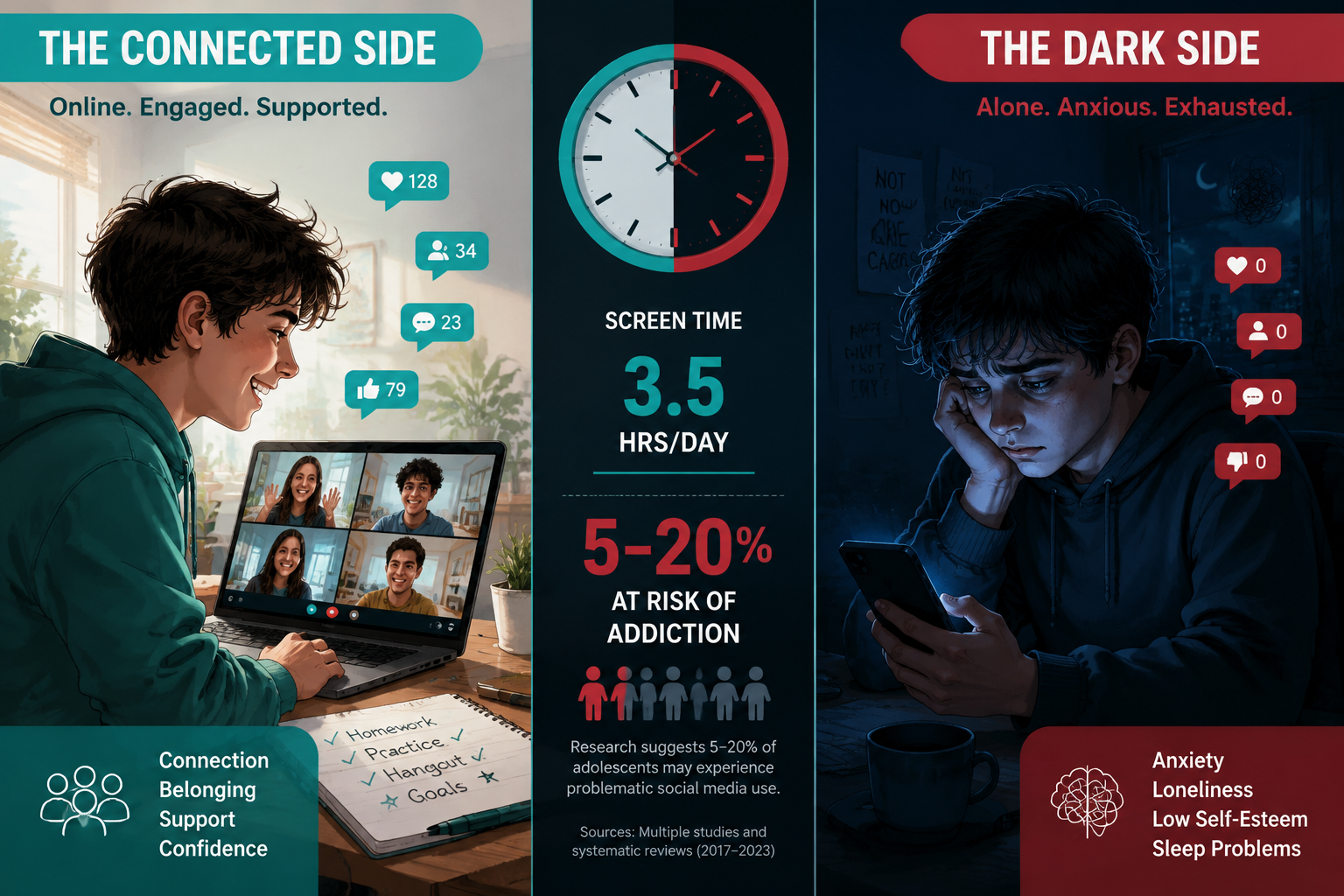
- Nearly two-thirds of teenagers use social media every day, with the average teen spending 3.5 hours daily on these platforms [2]
- Spending more than three hours a day on social media doubles a child’s risk of depression and anxiety symptoms [2]
- Between 5% and 20% of teenagers meet clinical criteria for social media addiction [1]
- Cyberbullying, body image pressure, and fear of missing out are among the most documented harms
- Platforms like TikTok and Snapchat are specifically designed with features that encourage compulsive, repeated use
- Parents, educators, and mental health professionals all have a role in helping young people build healthier habits
- Evidence-based screen time limits and open family conversations can meaningfully reduce harm
How Widespread Is Social Media Use Among Young People Today?
Social media use among young people has reached near-universal levels. Approximately 95% of children ages 10–17 use social media constantly, with YouTube (90%) and TikTok (63%) ranking as the most popular platforms among adolescents [1]. The widespread use of these apps has fundamentally changed how young people communicate, learn, and form their identities.
What makes this especially concerning is the sheer volume of time involved. Teens now average between 3.5 and 5 hours daily on social media, and roughly 1 in 10 teens spend more than 12 hours a day on social media apps [1]. Media has become the dominant leisure activity for most young people, often displacing sleep, physical activity, and face-to-face connection.
The children’s use of these platforms is not passive. Many social media platforms are engineered to maximize engagement through infinite scroll, push notifications, and algorithmic content feeds that reward continued viewing. Understanding how social media captures attention — and keeps it — is the first step toward addressing the mental health impact it carries.
What Does the Research Say About Social Media and Mental Health in Children and Teens?
The evidence linking social media and mental health in children and teens is substantial and growing. Depression is the most common mental health concern appearing in studies of child and adolescent social media use, showing up in 27.9% of relevant research studies [1]. American teens ages 12–15 who use social media for three or more hours daily experience twice the risk of depressive symptoms and anxiety [1].
Research published through Clinical Psychological Science and cited by major public health bodies has found a strong link between heavy social media use and declining wellbeing in adolescents. The U.S. Surgeon General’s advisory specifically notes that the complex relationship between social media and mental health outcomes cannot be reduced to a single cause — but the pattern of harm is consistent across studies [2].
Among social media use behaviors, passive scrolling (watching without interacting) appears to be more harmful than active engagement. Teens who spend more time on social media consuming content without participating tend to show higher rates of social anxiety and feelings of dissatisfaction compared to those who use platforms to genuinely connect with others.
Is Social Media Addiction Real, and How Common Is It Among Teens?
Social media addiction is a recognized behavioral pattern, even if it doesn’t yet have a formal diagnostic code in all clinical manuals. Between 5% and 20% of teenagers specifically meet addiction criteria based on established behavioral benchmarks, including loss of control, withdrawal symptoms, and continued use despite negative consequences [1].
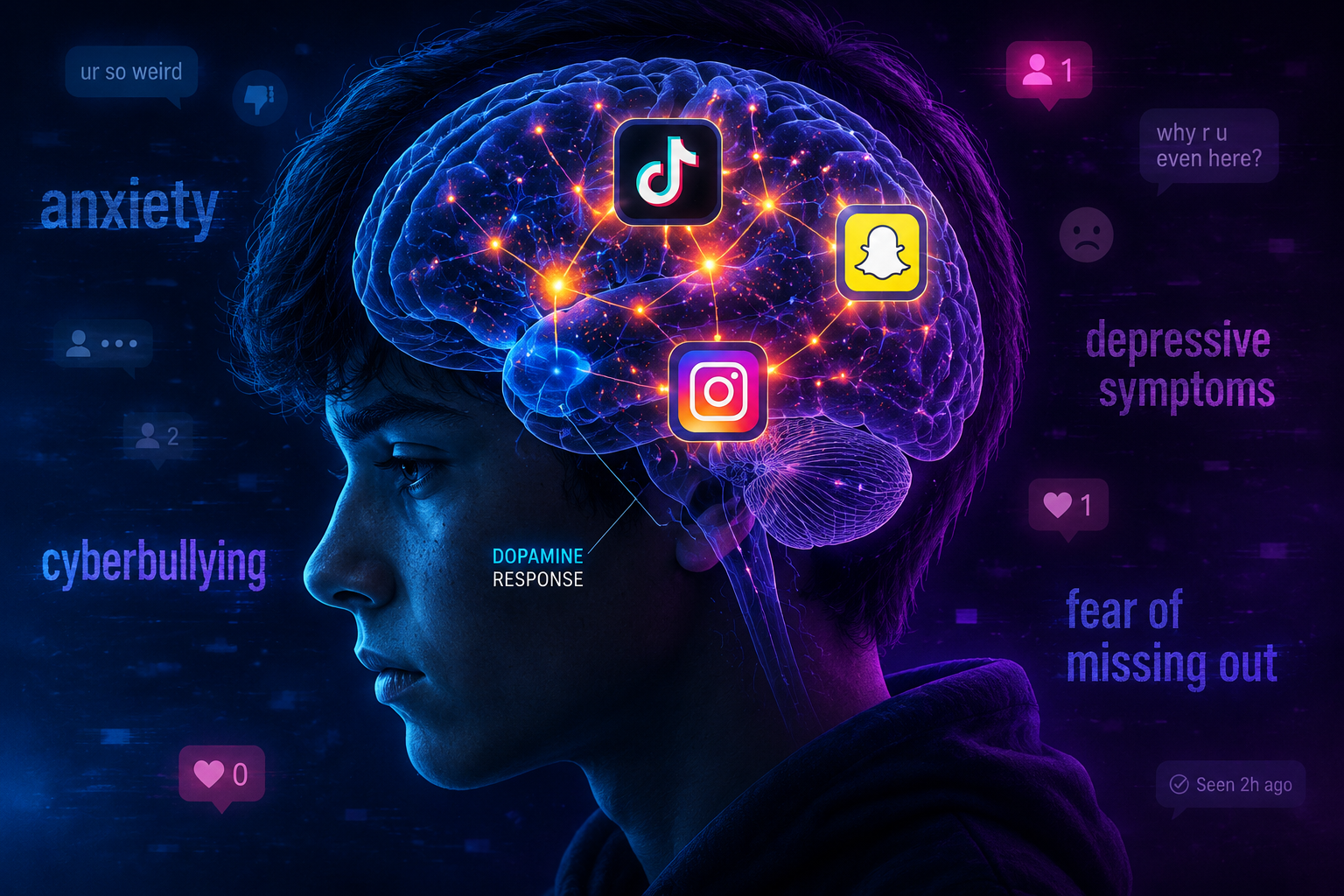
The design of platforms like TikTok and Snapchat plays a direct role. Features such as streaks, likes, and autoplay videos trigger dopamine responses in the brain similar to other reward-based behaviors. Teens who constantly check social media — refreshing feeds, monitoring likes, or responding to notifications within seconds — often report feeling unable to stop even when they want to. This compulsive pattern is the core of what mental health professionals classify as social media addiction [3].
Social media’s pull is particularly strong during adolescence because the teenage brain is still developing impulse control and is highly sensitive to social reward. A social media app that delivers instant peer validation taps directly into this vulnerability. The result is that many teens spend more time on social media than they intend to, often sacrificing sleep, homework, and real-world relationships in the process.
How Does Social Media Affect Mental Health: Depression, Anxiety, and Beyond?
Social media affect mental health through several overlapping pathways. The most documented are social comparison, cyberbullying, disrupted sleep, and exposure to harmful content. Each of these operates differently, but they often compound one another in a teenager’s daily experience.
When it comes to anxiety and depression, the numbers are stark. Nearly 60% of Facebook users in peer-reviewed research show signs of moderate depression, and more than 11% show severe depression [1]. Adolescents who spend 5 hours daily on social media are significantly more likely to report symptoms of depression than those who use it for less than one hour. The link between heavy social media use and suicide rates among young people is also documented: children and teens with social media addiction are 2–3 times more likely to experience suicidal ideation [1].
Cyberbullying is another major driver of harm. Unlike traditional bullying, cyberbullying follows a child home — it happens at any hour, often anonymously, and can involve spreading hurtful rumors to large audiences instantly. Research consistently identifies cyberbullying as one of the strongest predictors of poor mental health outcomes in adolescent populations. Approximately 1 in 5 teens report that their social media use has harmed their mental health or school performance [1].
Body image is a third major concern. When asked directly, 46% of adolescents aged 13–17 say social media makes them feel worse about themselves [2]. Instagram’s own internal surveys found that 8.4% of teen users aged 13–15 saw self-harm content in a single week, and the platform’s algorithm recommended more self-harm content in 97% of cases where users had previously viewed it [1].
What Are the Signs That a Teen’s Social Media Use Has Become a Problem?
A teen’s social media use has become problematic when it consistently interferes with sleep, school, relationships, or emotional regulation. Parents and caregivers should watch for these specific warning signs:
- Mood changes tied to phone use — irritability when the phone is taken away, or euphoria when getting likes
- Declining school performance without another clear explanation
- Sleep disruption from late-night scrolling or phone use in bed
- Social isolation from family and in-person friends
- Secrecy about what they’re viewing or who they’re talking to online
- Physical symptoms like headaches or eye strain from excessive screen time
- Feelings of anxiety when unable to access social media
High social media use doesn’t automatically mean addiction, but these behavioral changes signal that the relationship with social media has shifted from recreational to compulsive. Mental health professionals recommend treating these signs as early intervention opportunities rather than waiting for a crisis.
Who Is Most Vulnerable to the Negative Effects of Social Media?
Not all young people are equally affected. Adolescent mental health research points to several groups who face an increased risk of harm from heavy social media use.
Girls, particularly those aged 11–15, show higher rates of mental health deterioration linked to social media use than boys of the same age [4]. This may be because girls are more likely to engage in social comparison and appearance-based content, and are more frequently targeted by cyberbullying. Young adults who already have pre-existing mental health issues, including anxiety and depression, also tend to be more vulnerable to worsening symptoms when they spend more time on social media.
Children who begin using social media before age 13 — the minimum age on most platforms — face compounded risks because their brains are at a more sensitive developmental stage. Increased new media screen time during early adolescence has been linked to links to increased new media-related mental health challenges that can persist into adulthood [4]. The time we spend on social media in formative years appears to shape long-term emotional patterns in ways researchers are still working to fully understand.
What Is the Impact of Social Media on Teen Mental Health at the Population Level?
The impact of social media on teen mental health is not just an individual problem — it’s a population-level shift. Research presented in the 2026 World Happiness Report found that social media is harming adolescents at a scale large enough to cause measurable changes in population-level mental health data [4]. Rates of anxiety, depression, and self-harm among teenagers began rising sharply around 2012, coinciding with the widespread adoption of smartphones and social media platforms.
Youth mental health data from the U.S. Surgeon General’s office confirms that adolescents who report high social media use are more likely to report poor mental health and well-being across multiple indicators [2]. The mental health impact extends beyond mood disorders to include disrupted sleep patterns, reduced physical activity, and weakened real-world social skills — all of which feed back into poorer mental health outcomes over time.
Public health experts at Johns Hopkins University have noted that the challenge is not simply about screen time totals but about what young people encounter while online [5]. Exposure to harmful content, social media usage patterns that prioritize engagement over safety, and the design choices made by media users’ platforms all contribute to the broader mental health crisis.

How Can Parents and Teens Safely Use Social Media Without Sacrificing Wellbeing?
The goal isn’t to eliminate social media — it’s to safely use social media in ways that protect health and well-being. Here’s what evidence-based guidance recommends for families in 2026:
For parents:
- Set consistent screen time limits, especially during meals and the hour before bed
- Keep phones out of bedrooms overnight — this single change has a measurable effect on sleep quality
- Talk openly about what your child sees online, including cyberbullying and harmful content
- Use parental controls and platform-specific tools; many social media app settings now include usage dashboards
- Model healthy social media use yourself — phone use is contagious in households
For teens:
- Set a daily time limit and use your phone’s built-in tracker to stay accountable
- Unfollow accounts that consistently trigger feelings of anxiety or inadequacy
- Practice “intentional use” — decide why you’re opening an app before you open it
- Prioritize in-person connection; apps can help you stay connected to others, but they work best as a supplement, not a replacement
- If you feel you constantly check social media and can’t stop, talk to a trusted adult or counselor
A healthy relationship with social media is possible. The key is treating social media usage like any other habit — something that needs structure, awareness, and occasional adjustment. Just as you might track what you eat or how much you exercise, tracking time spent on social media gives you real information to work with.
What Role Should Schools and Policymakers Play in Protecting Youth Mental Health?
Schools and policymakers are increasingly being asked to act on the benefits and risks of social media for young people. Several U.S. states have introduced legislation restricting phone use during school hours, and early data suggests these policies improve both academic performance and social connection among students.
At the policy level, advocates are calling for stronger age verification requirements, algorithm transparency, and restrictions on features specifically designed to maximize engagement among minors. The Surgeon General has called on Congress to require warning labels on social media platforms similar to those on tobacco products [2]. The argument is that children’s use of these platforms carries documented risks that parents and young people deserve to be clearly informed about.
For schools, the most effective interventions combine digital literacy education with open conversations about mental health in young people. Teaching adolescents to critically evaluate content, recognize manipulation tactics, and build a healthy relationship with social media equips them with skills that last far beyond any single platform or policy.
Conclusion: Taking Action on Social Media and Youth Mental Health
The evidence is clear: the complex relationship between social media and youth mental health deserves serious, sustained attention from parents, educators, clinicians, and policymakers alike. Social media and an increased risk of depression, anxiety, cyberbullying, and even suicidal ideation in teenagers is not a fringe concern — it’s a documented public health reality.
The good news is that media and an increased risk of harm are not inevitable. Early intervention, open family conversations, evidence-based screen time guidelines, and platform accountability can all shift outcomes meaningfully. If you’re a parent concerned about your teen’s media habits, start with one conversation this week. If you’re a teen who recognizes these patterns in yourself, reaching out to a trusted adult or mental health professional is a sign of strength, not weakness.
For more resources on building overall health and wellbeing as a family, explore our complete guide to a healthier lifestyle in 2026. And if you’re navigating relationship stress that social media may be affecting, our guide on building lasting relationships offers practical, grounded advice.
Summary: Most Important Things to Remember
- Teens average 3.5–5 hours daily on social media — already above the 3-hour threshold linked to doubled mental health risk
- 5–20% of teenagers meet criteria for social media addiction, a behavioral pattern with real clinical consequences
- Depression is the most common mental health concern documented in adolescent social media research
- Cyberbullying, body image pressure, and harmful content exposure are the three most consistent harm pathways
- Girls aged 11–15 and teens with pre-existing mental health issues face the highest vulnerability
- Phones out of bedrooms overnight is one of the single most impactful changes a family can make
- Healthy social media use is possible with structure, awareness, and regular check-ins on habits
- Schools and policymakers have a role — digital literacy education and platform regulation both matter
- If a teen shows signs of addiction or distress, early intervention with a mental health professional produces the best outcomes
FAQ
Q: At what age should children be allowed to use social media? Most platforms set a minimum age of 13, but research suggests that delaying social media access until at least 14–16 reduces mental health risk, particularly for girls. The American Psychological Association recommends careful parental involvement at any age.
Q: How many hours a day on social media is considered too much for a teen? More than three hours a day on social media is the threshold at which research consistently finds doubled risk of depression and anxiety in adolescents [2]. The average teen currently exceeds this threshold.
Q: Can social media ever be good for teen mental health? Yes. When teens use social media to connect with others, find supportive communities, or pursue creative interests, it can support wellbeing. The harm tends to come from passive, compulsive, or comparison-driven use rather than intentional, social use.
Q: What is the difference between heavy social media use and addiction? Heavy use means spending a lot of time on platforms. Addiction involves loss of control, withdrawal symptoms, and continued use despite clear negative consequences. Between 5% and 20% of teens meet addiction criteria [1].
Q: Does TikTok cause more harm than other platforms? TikTok’s algorithm is particularly effective at keeping users engaged through short-form video autoplay, which research suggests is especially linked to compulsive use patterns. However, harm varies by how any platform is used, not just which one.
Q: What should I do if I think my child is addicted to social media? Start with a calm, non-judgmental conversation. Set clear boundaries around screen time, remove devices from bedrooms, and consult a mental health professional if the behavior is significantly affecting school, sleep, or relationships.
Q: Is cyberbullying more harmful than in-person bullying? Cyberbullying can be more damaging in some ways because it follows a child home, can be anonymous, and can reach large audiences instantly. It is consistently linked to higher rates of depression, anxiety, and suicidal ideation in adolescent research.
Q: Can apps help teens manage their social media use? Yes — apps can help teens track and limit their own usage. Built-in screen time tools on iOS and Android, as well as third-party apps, allow teens to set daily limits and receive usage reports.
References
[1] Statistics – https://www.sokolovelaw.com/personal-injury/social-media-addiction/statistics/
[2] Index – https://www.hhs.gov/surgeongeneral/reports-and-publications/youth-mental-health/social-media/index.html
[3] Why Is Social Media Addictive In 2026 – https://www.sokolovelaw.com/blog/why-is-social-media-addictive-in-2026/
[4] Social Media Is Harming Adolescents At A Scale Large Enough To Cause Changes At The Population Level – https://www.worldhappiness.report/ed/2026/social-media-is-harming-adolescents-at-a-scale-large-enough-to-cause-changes-at-the-population-level/
[5] Media Briefing Social Media Mental Health – https://publichealth.jhu.edu/2026/media-briefing-social-media-mental-health